
Selling online is not, mostly, a website problem. The cart and the checkout page are the visible part, but the work that actually determines whether the store succeeds sits underneath it: photographing products so they look like something worth buying, writing descriptions that answer the questions a shopper would otherwise ask in person, deciding how shipping is priced and who pays for returns, setting up payment processing, and handling sales tax across whatever states you ship to. A beautiful store sitting on top of sloppy answers to those questions will still struggle. Get them right and even a simple store performs.
I say this upfront because a lot of the "we need an e-commerce site" request turns into a longer conversation about all of the above, and that conversation is worth having before any code gets written.
Platform or custom build — the honest tradeoff
There are two real paths, and which one wins depends on the business, not on which one sounds more impressive.
A hosted platform — something built for e-commerce out of the box, with inventory management, payment integrations and a plugin ecosystem already solved — is usually the right call for a business with a large, changing catalogue. If you carry a couple hundred products and your inventory shifts week to week, you want tools built specifically for that job, not a custom system I would be building and then maintaining piece by piece. I will say so plainly even though it means recommending a platform over a custom build.
A hand-built store suits a different shape of business: a focused catalogue that does not change constantly, a brand where the design itself is part of the pitch, and a case where a fast, lean, purpose-built site is a real differentiator rather than a nice-to-have. If that is closer to what you have, hand-coding gives you a store with nothing extra running in the background — no plugin ecosystem to maintain, no general-purpose engine doing work your specific catalogue does not need.
Checkout and trust
A cart gets abandoned at the exact moment doubt outweighs the desire to buy, and price is only one of the things that can tip it. A checkout that asks for an account before it lets someone buy, that surprises a shopper with shipping costs at the last step, or that simply feels unfinished gives a hesitant buyer a reason to leave instead of a reason to stay.
A checkout that works is fast, asks for the minimum it needs, shows costs before the final step, and looks like it belongs to a real, trustworthy business — clear contact information, a real return policy, nothing that feels improvised. None of that guarantees a sale. It just removes the reasons that were never about your product in the first place.
What I do, and where the boundary sits
For a platform build, I handle setup, design, product page structure and the technical side of getting it live and connected correctly — the platform itself handles the cart, inventory and payment plumbing. For a hand-built store, I build the storefront and checkout flow directly, the same way I build any other site: by hand, for speed. In either case, I do not run your inventory, write your product descriptions from nothing, or manage your shipping accounts day to day — that is the part of the business only you can run.
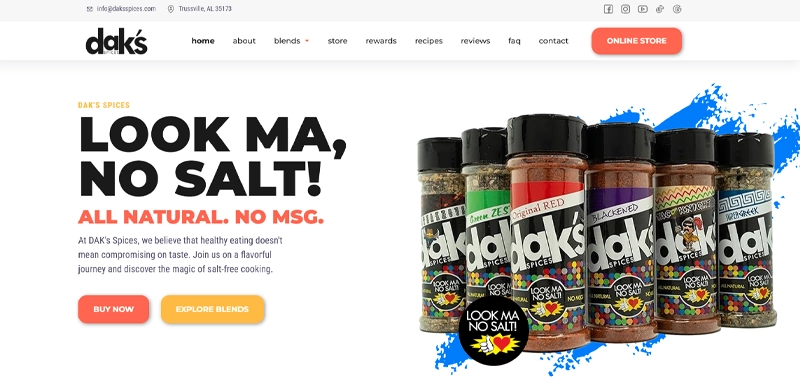
One live example of this work is the storefront I built for DAK's Spices, which you can see in the portfolio.
If your store also needs to be found by people searching for what you sell, that is the same web design foundation — speed, structure and real content — that every site I build starts from.
Start with a conversation
Tell me what you are selling and roughly how large the catalogue is. We will work out together whether a platform or a custom build actually fits — that comes before any talk of building either one.
Ready to Grow Your Business Online?
Get a free, no-obligation quote today. Based in Birmingham — working with businesses everywhere. I'll review your online presence and show you exactly where you're leaving money on the table.
Get My Free Quote →