
Most businesses I come across in Vestavia Hills do not serve one town. Vestavia Hills sits next to Homewood, Hoover, Mountain Brook and Birmingham itself — separate municipalities, minutes apart by car — and a landscaper, a dentist, or a contractor based here is usually happy to take a job from any of them. That is a reasonable way to run a business. It is a harder problem to solve on a website, and it deserves more than one page trying to cover all of it at once.
Your customers are spread across a map, not a city
If you serve Vestavia Hills and its neighbors more or less equally, the honest description of your service area is not a single place. It is a cluster of places, and a website built around "Vestavia Hills" alone undersells that, while a website that names none of them by name undersells it just as badly. The problem is not that you have too small an area. It is that you have several areas, and most small business sites are not built to say so clearly.
The footer list is not for the business — it is for the visitor
The usual answer to this is a footer line: "proudly serving Vestavia Hills, Homewood, Hoover, Mountain Brook and the surrounding area." I understand the impulse — it feels like covering your bases. But think about who actually reads it. Someone in Homewood searching for a business near them does not want to find their town's name buried in a sentence at the bottom of someone else's page. They want a page that is actually about being served in Homewood — what you do there, and why it is worth calling you instead of a business that put more than a name in it. A list in a footer answers nobody's question. It just tells a visitor that this site knows the town exists.
Put yourself in that visitor's place for a moment. They found your site by searching for something specific to where they live, they land on a homepage built around Vestavia Hills, and the only sign their own town matters to you is one word in a sentence at the bottom. That is not a warm welcome. It reads as an afterthought, because it is one — a name added to satisfy a box that felt like it needed checking, not a place you actually wrote anything for.
The pattern: one real page per place, done honestly
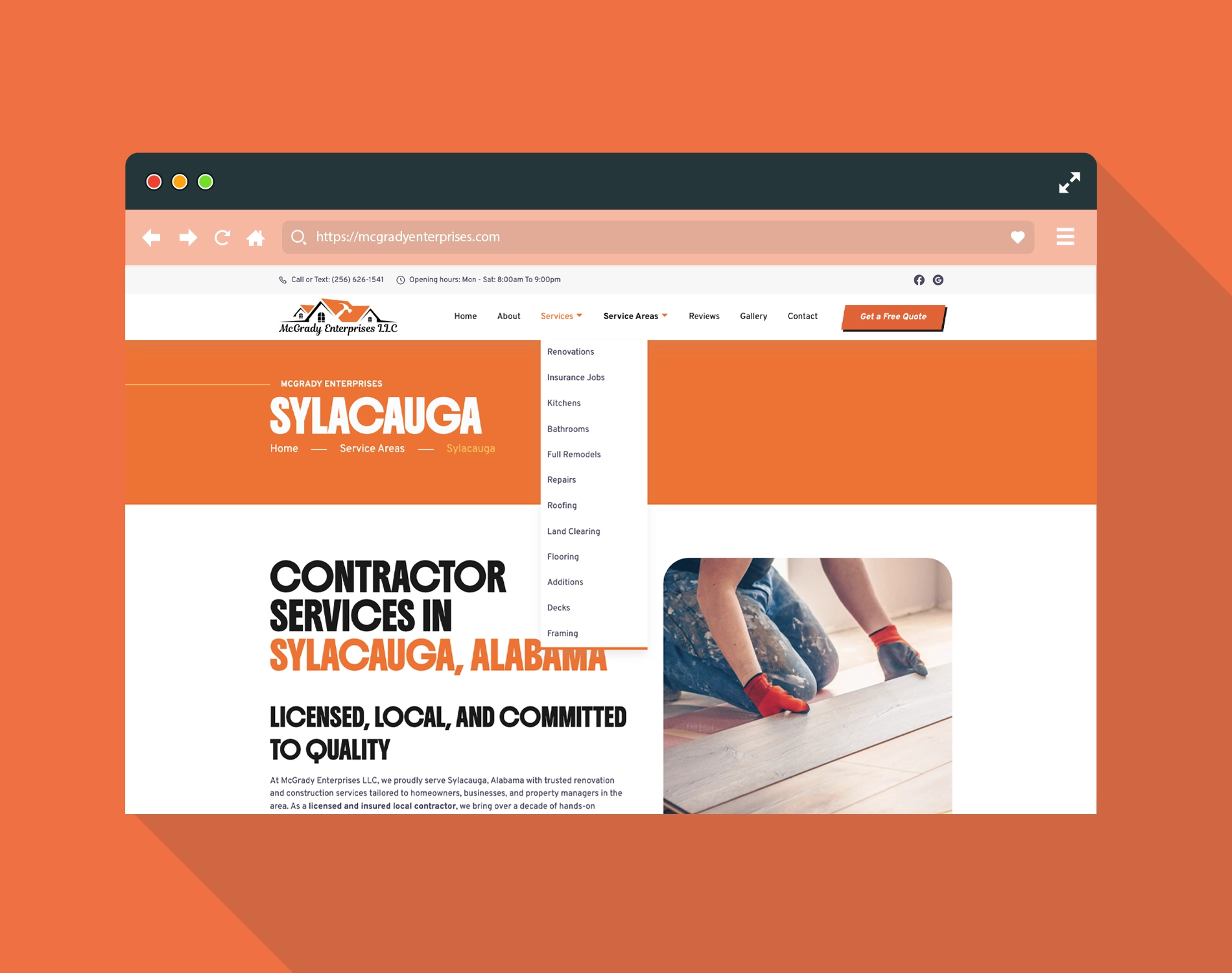
The structural fix is a page per place you genuinely serve, each one written around that place specifically — not a longer list, and not five copies of the same paragraph with the town name swapped. A contractor I worked with across several central Alabama cities built exactly this: separate pages for the different places they actually worked, each one saying something real about serving that place, rather than one page trying to be about all of them.
I will say plainly what makes this work and what breaks it: it only works if each page has something genuine to say. A page that just swaps in a new town name over otherwise identical text is a thin duplicate, and a reader can tell in about two seconds — the paragraph never actually describes their town, it just contains its name. I am not going to build a set of pages like that for you, because it would not do what you are paying for. Writing several genuinely different pages takes longer than writing one page and copying it four times. That extra time is the whole point — it is the difference between a set of pages that reads as real and a set that reads as a trick, and in every case I have seen, the visitor who spots the trick leaves rather than calls.
Deciding which places earn a page
Not every place within driving distance deserves its own page. The right test is where your customers actually come from — the towns you can point to and say "yes, a meaningful share of my work comes from there" — not everywhere you would theoretically accept a job. A page built for a place you serve once a year has nothing real to say and will read that way. Start with the two or three places that are actually true, and add more only when a new one becomes true as well. Working that out is part of what local SEO means in practice — it is decided by looking at where your customers actually are, not by picking towns off a map.
This site is itself an example of that discipline: it currently covers four places, not a longer list, because those are the ones with something genuine behind them. More will be added when they are earned, not before.
What I do
Most of the work on a project like this happens before any page gets built: working out, with you, which of the places you serve have enough behind them to support a real page, and which are better left as a mention than turned into a landing page of their own. Once that list is settled, each page gets built by hand around what's actually true for that place — its own paragraph of reasoning, not a shared template with the name changed.
I'm based in Birmingham, close enough to meet in person if you'd rather work through that list across a table, though the list itself matters far more than where either of us happens to be sitting.
Where to start
Send me a rough list of everywhere you currently think you serve. Part of what I'll come back with is which of those places actually earn a page and which don't — sometimes that list gets shorter before it gets longer, and I'd rather tell you that than build pages that won't hold up.
Ready to Grow Your Business Online?
Get a free, no-obligation quote today. Based in Birmingham — working with businesses everywhere. I'll review your online presence and show you exactly where you're leaving money on the table.
Get My Free Quote →