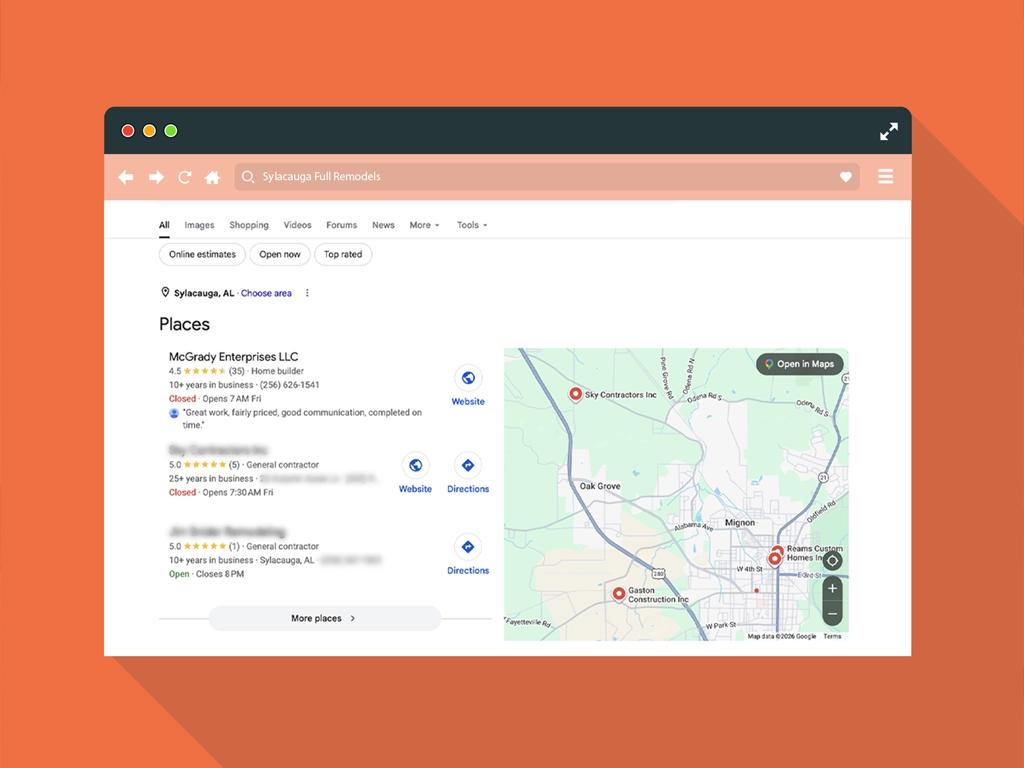
If you run a business that serves more than one town, you've probably hit a frustrating wall on Google. You do great work in five, ten, a dozen different cities — but your website only seems to show up in the one where you're headquartered. Everywhere else, you're invisible, and the phone stays quiet. I see this constantly with contractors, home-service pros, and anyone with a service area bigger than a single ZIP code. The good news is that it's fixable — and one of my clients is a great example of what "fixed" looks like.
Meet McGrady Enterprises
McGrady Enterprises is a licensed contracting company based in Sylacauga, Alabama, founded by Tyler McGrady in 2015. They handle everything from framing and repairs to full kitchen and bathroom renovations, decks, flooring, roofing, and new construction. And crucially, they don't just serve Sylacauga — they work across Central Alabama, including Childersburg, Talladega, Birmingham, Montgomery, and the surrounding communities. That's a business with a lot to offer in a lot of places. The challenge was making Google understand all of it.
The Mistake Almost Every Local Business Makes
Here's how most contractor websites are built: one page called "Services" that lists everything in a big bulleted paragraph, and one page called "Areas We Serve" with a list of city names. It feels efficient. It's also exactly why those sites struggle to rank.
Google's local search doesn't reward a page that mentions twelve services and ten cities in passing. It rewards the page that most specifically and thoroughly answers the exact thing someone typed. When a homeowner in Talladega searches "kitchen renovation Talladega," Google is looking for a page that is genuinely about kitchen renovations in Talladega — not a page that lists "kitchens" as item four of nine and "Talladega" as city six of ten. A single catch-all page can't be the best answer to hundreds of specific searches, so it ends up being a mediocre answer to all of them.
Fix #1: Give Every Service Its Own Page
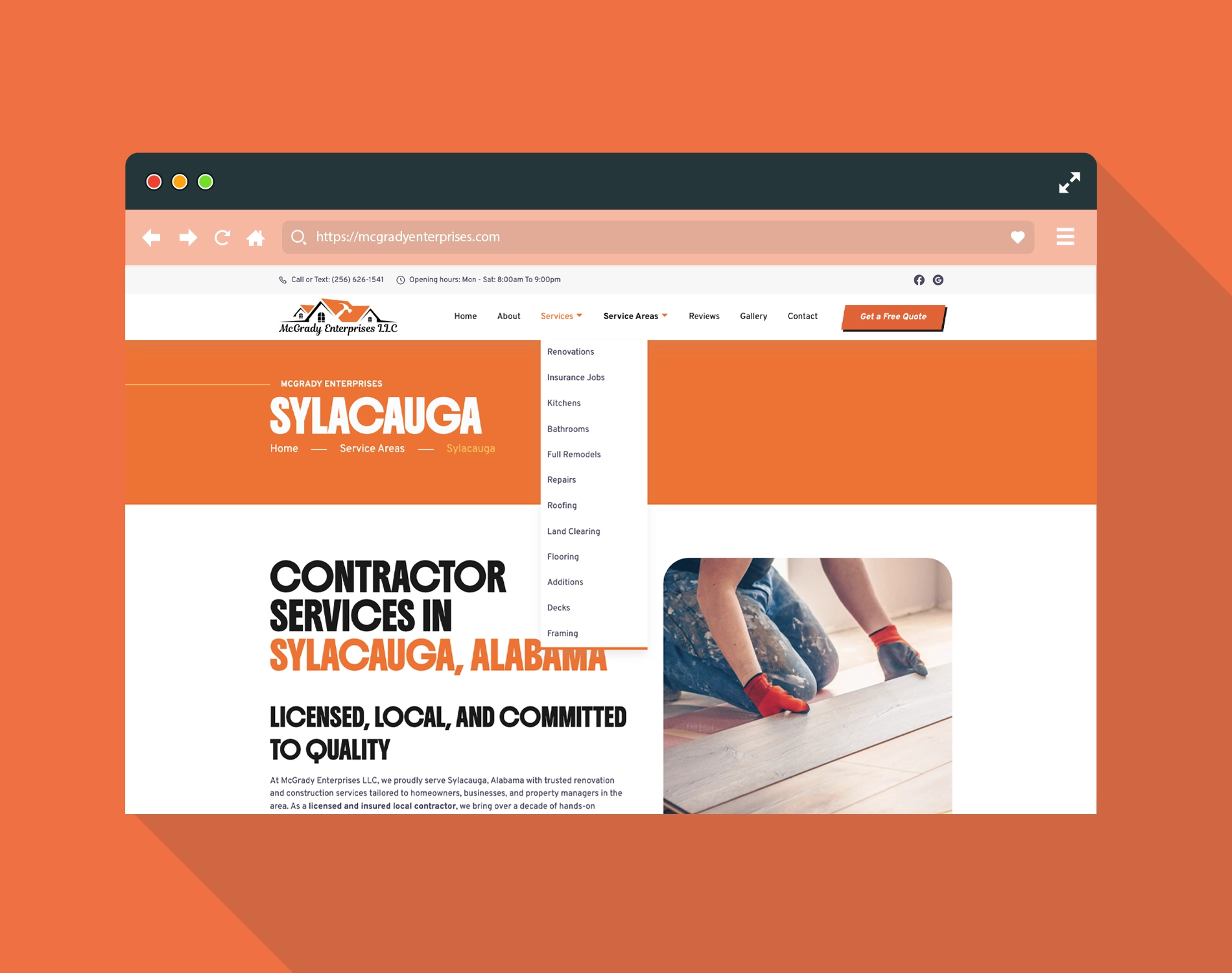
The first thing we did was break the services apart. Instead of one crowded "Services" page, McGrady Enterprises now has a dedicated page for each core service — framing, renovations, repairs, and so on. Each page gets room to actually say something useful: what the service includes, how the process works, what makes McGrady's approach different, and the questions customers actually ask. That depth is good for the reader and it's exactly what Google needs to confidently rank the page for that specific service. One page trying to rank for everything ranks for nothing. Ten focused pages, each clearly about one thing, give you ten real shots at the top of search. It's the same approach we take with every website we build.
Fix #2: Give Every City Its Own Page
Next, we did the same thing for the service area. Rather than a single list of city names, McGrady Enterprises has individual service-area pages — a real page for Birmingham, a real page for each community they serve. A proper service-area page isn't just the homepage with the city name swapped in. It speaks to that specific community: the kinds of homes and projects common there, the fact that McGrady is licensed and insured to work in that area, and a clear invitation to get a quote. To someone in that town, it reads like a local contractor who knows their area — because that's true.
When you combine the two ideas, something powerful happens. Now you're not just ranking for "kitchen renovation" or "Birmingham contractor." You're positioned for the specific, high-intent searches people actually make: "home repairs Childersburg," "deck builder Talladega," "kitchen remodel near Sylacauga." Those are the searches that turn into phone calls.
Why This Works
Local SEO rewards relevance and specificity. Every individual service page and service-area page is another door into the business — another highly relevant page that can rank, get found, and send a ready-to-hire customer to the contact form. It also compounds: each new page strengthens the overall site's authority for that region and those services, so the whole thing performs better over time. For McGrady Enterprises, that's meant showing up for city-specific searches across Central Alabama, well beyond their home base in Sylacauga. You can see more results like it in our web design portfolio.
How to Apply This to Your Business
You don't have to be a contractor for this to work. Any business that offers multiple services across multiple areas can use the same playbook:
- List out every service you offer — and give each one its own page with real, specific content.
- List out every city or area you serve — and build a genuine page for each, written for that community rather than copy-pasted.
- Be specific, not generic. One thorough page about one thing beats a thin page about everything.
- Tie it all together with a complete Google Business Profile and consistent name, address, and phone across the web.
It's more pages and more work up front. But it's the difference between being findable in one town and being findable in every town you serve.
Conclusion
If you're doing great work across a whole region but only getting found in your own backyard, that's a fixable problem — and usually one of the highest-return investments a local business can make. At Ridgeway Web, we build fast, hand-coded websites with the service and service-area pages that win local search. Contact us today for a free, no-pressure look at your site, and we'll show you exactly where the opportunities are — just like we did for McGrady Enterprises.